
Checking for a Warrant in Clay County
Clay County gives the public no name-search portal. Georgia's official warrant guidance sends you instead to the sheriff of the county where the warrant might exist. Before you call, write down your full legal name, date of birth, and any case or citation number you know. Worried about arrest? Have a lawyer make first contact with the office and the court. A careful Clay County warrant records check always traces back to whoever issued the order in the first place.
- Call the Clay County Sheriff at 229-768-2505 and ask how confirmation is handled.
- Read any citation, summons, or case paper for the issuing court.
- Contact the correct Superior, Magistrate, Probate, or municipal clerk.
- Use a written Open Records request for a specific existing, non-exempt document.
- Ask counsel and the issuing office for bond, surrender, hearing, or recall instructions.
One Clay County search never covers other counties, other states, or federal court. Check each of those jurisdictions on its own.
No Statewide Georgia Warrant Database
Georgia runs no single public statewide warrant lookup. State guidance tells residents to contact the sheriff of the right county directly. Some sheriffs answer questions over the phone. Others want you at the counter in person. That county-by-county setup makes the Clay County Sheriff's published office line the best first call when you don't know which court issued a warrant.
Before visiting: Georgia warns that an in-person request can result in immediate custody if the person has an active warrant.
If staff tell you to come in, bring government-issued photo identification. Once you reach someone, ask three things right away: which office handles warrant questions, whether phone confirmation is possible, and which court owns the case. Direct Sheriff requests are free under the state guidance. A formal Open Records Act request for copies is different, and lawful search or copying costs can apply there.
Clay County Warrant Types
Clay County courts and law enforcement work with several distinct records. An arrest warrant comes after a finding of probable cause, and it authorizes an arrest. A bench warrant usually follows a missed court date. So does an order for arrest. A search warrant lets officers search a described place or item, and it is not a public people-search record. Traffic and municipal warrant questions depend on the court printed on the citation itself.
| Warrant Type | How It Arises | Local Route |
|---|---|---|
| Arrest warrant | Probable-cause application | Magistrate or other issuing court; Sheriff for service |
| Bench warrant | Missed date or disobeyed court order | Issuing clerk or judge |
| Search warrant | Judicial approval to search | Issuing court or agency, subject to access limits |
| Traffic order for arrest | Missed citation setting or noncompliance | Named court; Probate where it owns the citation |
You may run across the word "capias" in legal records. Clay County's own public-facing wording is simpler: "bench warrant" or "order for arrest for failure to appear."
Which Clay Courthouse Suite?
The Clay County offices directory places three court offices at 210 Washington Street South in Fort Gaines. Superior Court sits in Suite 3, at 229-768-2631. Magistrate Court occupies Suite 5, at 229-768-2841. Probate Court is Suite 1, at 229-768-2445. Superior and Magistrate list weekday hours of 8:00 a.m. to 4:30 p.m., and the clerk directory notes Superior stays open through lunch.
Superior Court, Suite 3
Felony and general criminal case files
Magistrate Court, Suite 5
Preliminary hearings and stated warrant jurisdiction
Probate Court, Suite 1
Traffic citations and arraignment route
All three Clay County offices share one address, not one counter. Each court keeps its own records, so match the court name on your paper before you drive over.
Inside a Clay County Warrant Record
Clay County publishes no sample warrant entry, so no local field layout can be promised. A real warrant or court record may hold an identifier, a linked case number, the issue date, the issuing court, the alleged offense, bond terms, the serving agency, and current status. What you can see depends on the record holder.
| Warrant identifier | Local number or reference; format not verified. |
|---|---|
| Case link | Citation, accusation, indictment, or related court case. |
| Issue details | Date, court, county, or judicial officer as recorded. |
| Bond | Amount or type if set; Clay publishes no general schedule. |
| Status | ACTIVE / SERVED / RECALLED or another office term. |
Treat legal existence, service, bond, and final disposition as four separate questions in Clay County, because a record can lag behind a later court order.
Clay Sheriff Confirms Service
The official Sheriff page describes the department's duties plainly. It serves criminal warrants inside Clay County and for other counties and states alike. The same office handles booking and bonding reports, inmate information, bailiff work, court security, patrol, investigations, and civil process. Don't mix up civil writs or subpoenas with criminal arrest warrants. The Sheriff works from 124 Thomas Street, Suite 1, Fort Gaines, GA 39851. The main number is 229-768-2505, and the 2026 Georgia Sheriffs' Association directory lists it as an office and 24/7 contact. Clay County posts no separate warrant hotline, public warrant search, surrender hours, or bond window. Call the main number and ask to be routed. The courthouse sits at a different Washington Street address. The county's own page on the Sheriff's site lays out the criminal-warrant service description in full: view it on the county site.
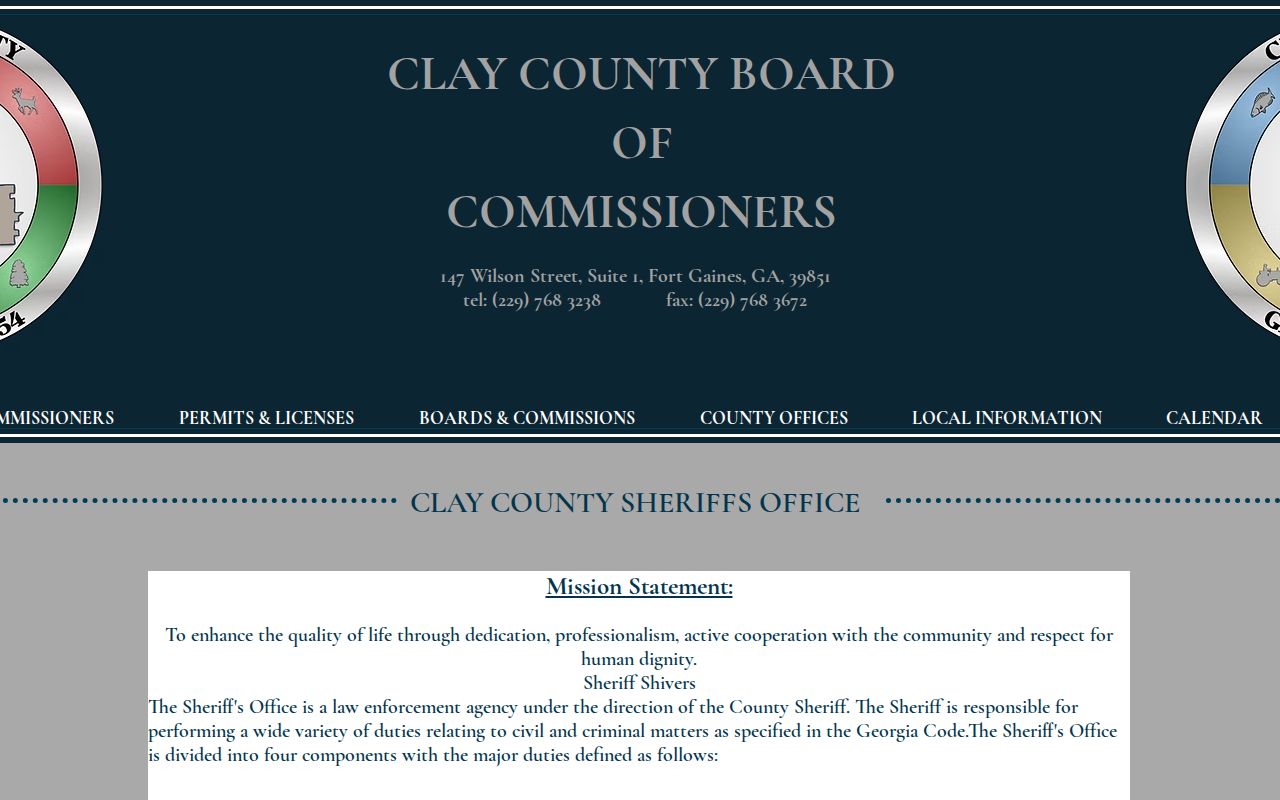
That page confirms Clay County's serving role, but the issuing court remains the only source for recall or final disposition.
Issuing and Serving Warrants in Clay County
In Clay County, a judicial officer issues a warrant only on the legal showing required for that type of order. The Magistrate Court's published jurisdiction block names summonses, arrest warrants, and search warrants expressly. It also covers preliminary hearings and certain minor criminal matters. Superior Court is the county's highest trial court. Felonies and broader criminal cases travel that route. Once issued, a warrant is executed by the Sheriff or a police agency. The clerk keeps the court record. A prosecutor handles the underlying criminal case. Georgia Rule 24.2 governs return of the original warrant to the magistrate court or its designee after an arrest. Rule 25.1 then covers first appearance, rights advisement, a commitment hearing, and bail consideration, with first appearance generally within 72 hours of arrest unless bond is made first. This division of labor is exactly why one phone call in Clay County may not settle status, bond, and case outcome all at once.
Clay Sheriff and Courthouse Map
Two stops, one town. Clay County keeps its courthouse and Sheriff's Office at separate addresses, so plan the trip around whichever office holds the record you need. The courthouse went up between 1871 and 1873 and was remodeled in 1970. National Register material describes white-painted brick, a portico, and heart-of-pine floors. The clerk directory offers a plainer landmark: a large white building across from Baptist Church, with the clerk's office last on the right. Verify those details before you drive.
Courthouse
210 Washington Street South
Superior, Magistrate, and Probate routes
Sheriff
124 Thomas Street, Suite 1
Warrant service, booking, and bonding records
The official county directory confirms Clay County office locations. Old buildings do not shift which office answers.
If You Have a Warrant in Clay County
If a Clay County warrant carries your name, talk to a lawyer first and pin down the issuing court before you walk in. Ask the practical questions up front. Where does surrender happen: the Sheriff, the courthouse, or another agency? Is the warrant bondable, who set the amount, and which bond type will the court take? Find out whether a first appearance or a later hearing is still required. Clay County publishes no universal bond schedule and no surrender form, so the answers come one case at a time. From there, the lawful routes are few and clear. A person can surrender voluntarily, arrange it through an attorney, post bond when the court allows it, or file a proper motion asking the issuing judge to recall or quash the warrant. Recall means the court withdraws it; quash means the court sets it aside. A bench matter may just need a new date or a written explanation, while a traffic matter may turn on payment and reinstatement. Only the issuing court can confirm that a warrant's status actually changed.
Important: Keep every court order, bond paper, receipt, and written status confirmation after taking steps to resolve a Clay County warrant.
Clay Bond Questions Without a Schedule
Clay County has no published bond schedule, so the questions matter more than the numbers. Clay Magistrate Court says its magistrates may grant bail unless another judge holds that power exclusively. The Sheriff's side handles the mechanics: booking and bonding staff prepare bonding reports for people who post bonds. Beyond that, neither office publishes a standard warrant amount, a surety-company list, a payment method, or bond-window hours. So ask directly. Is the warrant bondable at all? Did the court set cash, surety, property, personal recognizance, or no bond pending a judge? Confirm where bond gets posted, and whether court costs and citation payments are separate. Then ask how the court and the Sheriff will record the update, because posting a bond does not by itself end the case or cancel a required appearance. Georgia's first-appearance rules frame the process, but the warrant type and the facts control it. Never borrow a dollar figure from another county or a commercial listing.
Clay County Warrant Records and Public Access
Clay County records requests run through the Georgia Open Records Act, O.C.G.A. § 50-18-70 et seq., which guarantees access subject to exemptions. Put the request in writing. Send it to the agency's custodian, and describe records that exist rather than demanding a new report. Per the Attorney General, the agency generally must respond within three business days, either producing records or explaining availability, exemptions, timing, and cost.
Key Rules:
O.C.G.A. § 50-18-70 states the broad access principle, subject to lawful limits.
O.C.G.A. § 50-18-71 governs response and production mechanics, including reasonable costs.
O.C.G.A. § 50-18-72 permits exemptions for records such as protected investigative, source, juvenile, and personal material.
A denial or redaction does not mean no warrant exists in Clay County. Ask the issuing court or the Sheriff for direct personal confirmation.
Open Records Fallback in Clay County
When a phone call will not produce a releasable document in Clay County, a focused open-records request will. The Attorney General's form asks for the date, the agency, a fax or email, a description, and the requester's name and contact information. Aim it at the right custodian. Sheriff custodians handle defined service, booking, bond, or return records. The Clerk of Superior Court, or another issuing clerk, holds the court-side records. Give a date range and a record category, and ask for non-exempt portions with protected details redacted. An agency does not have to build a new all-warrants spreadsheet if none exists. Costs can apply, and state guidance allows copying charges up to 25 cents per page, so request an estimate for a broad search. The county office directory shows each Clay County office and its custodian before you submit.
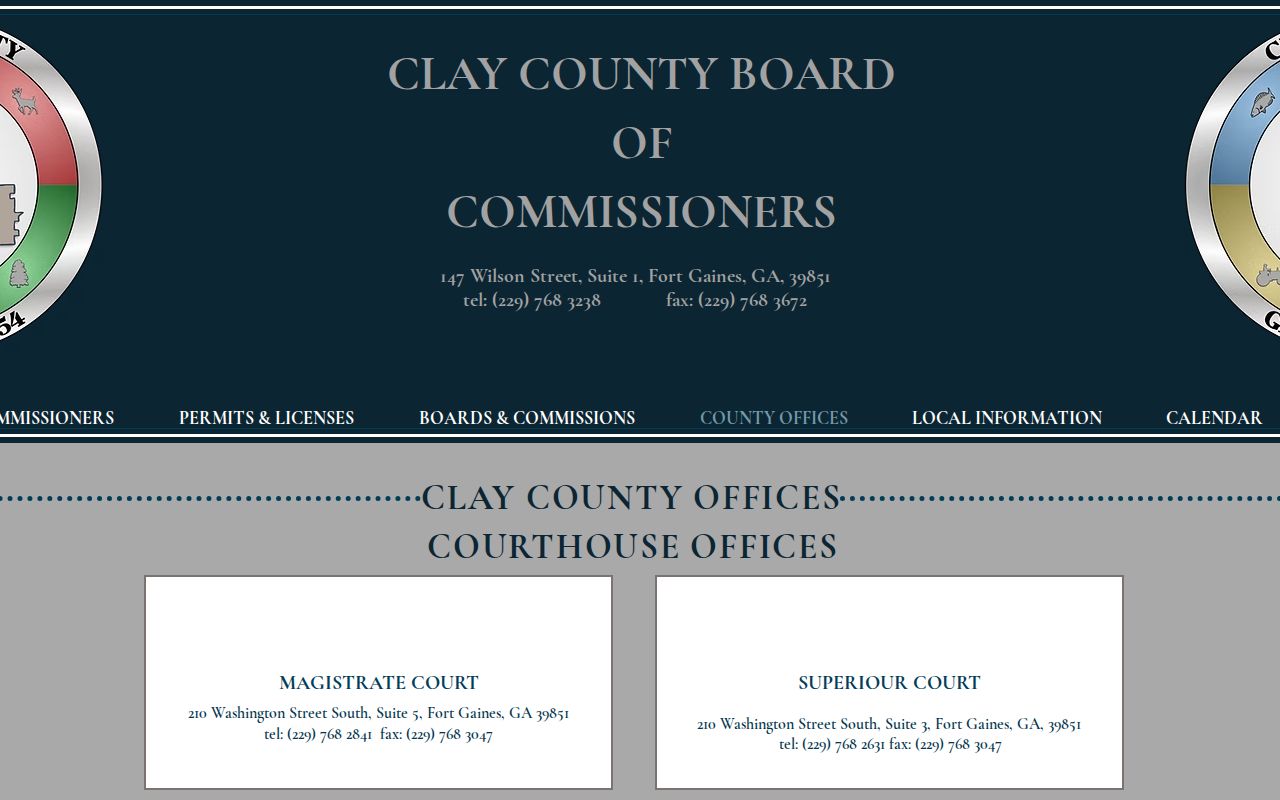
The directory reinforces that the courthouse and Sheriff records routes are not interchangeable.
Clay Citation Status Checkpoints
Clay Probate Court runs traffic citations for Clay County and links to EZCourtPay for payment. In person, it takes cash, money order, or cashier's check; by mail, money order or cashier's check only. Personal checks are not accepted. Pay before arraignment and, under the county's instructions, you can avoid an appearance; contest the ticket instead and you should come to arraignment, plead not guilty, and get a later hearing. Georgia keeps no centralized traffic-citation database. The state warns that court vendor results can take 7 to 21 business days after issuance. Citation paperwork carries Warrant Issued and Warrant Served fields, and it cautions that failure to appear can trigger a DDS suspension until a satisfactory disposition or court notice. Treat payment, warrant recall, court disposition, and DDS reinstatement as separate checkpoints. Keep your proof. Then ask the named court what still remains.
Clay County and Federal Warrants
Clay County sits in the Middle District of Georgia's Columbus Division, and federal warrants live in a different world from county records. Federal docket research runs through PACER, not a county warrant list. PACER is a case-record system, and sealed complaints or warrants may not appear there. The federal courthouse in Columbus sits at 120 12th Street, Columbus, GA 31902, with a main number of 706-649-7816. The U.S. Marshals Service Columbus contact is 706-649-7822. A federal warrant has to run through the federal court, the U.S. Marshals, a federal defender or private counsel, or the issuing agency. Clay Sheriff records cannot substitute for that confirmation. The Middle District also warns about fake warrant demands arriving by text, email, or phone. An urgent push for remote payment is not proof of a real order. Verify through published government contact information.
Clay County Warrants by City
Clay County, Georgia, has just two incorporated cities, not five. Fort Gaines serves as the county seat and counted 995 residents in the 2020 Census, while Bluffton counted 113. For citations or municipal matters, the city that issued the paperwork controls the record. Fort Gaines publishes no official warrant search, and Bluffton runs no separate municipal warrant page of its own. For criminal cases, the Clay Sheriff remains the office to contact in Clay County.
Fort Gaines
Population 995 · City Police and City Hall can help identify a city-issued citation or court.
Bluffton
Population 113 · No separate official city portal was located; use verified Clay County routes.
Bluffton, Georgia, is not Bluffton, South Carolina, so check the right state before you search Clay County records. The city that issued the warrant controls it.